Cart title
There are no more items in your cart

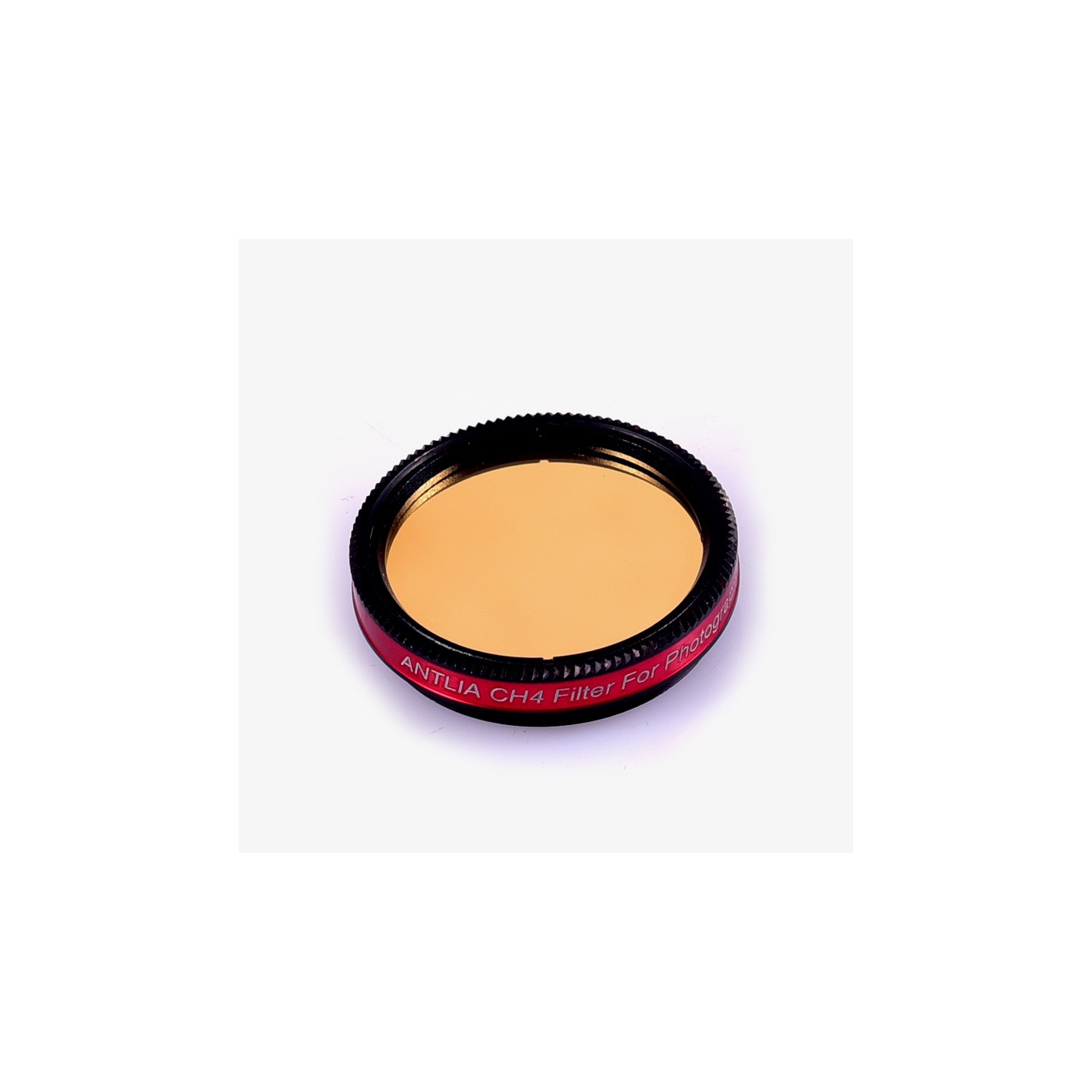
The Antlia methane (CH4) filter is a specialized filter that allows light in the near-infrared portion of the spectrum centered at 889 nm to pass through with a bandpass 20 nm wide. This filter was developed to be able to measure with greater detail and contrast the methane characteristic of Jupiter, Mars, Saturn and other planets.
| Carrier | Description | Estimated Delivery | ||
|---|---|---|---|---|
 |
UPS - Resto del mundo | UPS - Rest of the World |
Friday, 20 February - Friday, 27 February |
|
UPS - Resto del mundo
UPS - Rest of the World
Estimated delivery:
Friday, 20 February - Friday, 27 February
The human eye is not sensitive to light beyond about 700 nm, so no person can see what this filter transmits, so this filter is not suitable for visual applications.
The Methane (CH4) filter is recommended for planetary images such as Mars, Jupiter, Saturn and the other planets.
For good results, you will probably need relatively longer exposure times and a larger aperture telescope with this filter than with other filters.
Optical substrate
Thickness: 1.25" (2 mm+/-0.05 mm)
Surface quality: 60/40 (see MIL-O-13830)
2-sided fine optical polishing to ensure an accurate 1/4" wavefront
30 arc second parallelism
Antlia CH4 filter center wavelength: 889 nm
Tave>90% , 90% transmission at 889nm
OD5(0.001%)@ 200-1050nm
2-sided Multilayer anti-reflection coating
Single substrate/non-glued
1.25"(M28.5*0.6)
Ultra-thin filter cell to minimize vignetting while maximizing the clear aperture possible
Black anodized finish
No Fading Laser Engraving
1. when attempting to image the Sun with CH4 filters please note that this is not for visual applications
2. If an energy rejection filter is not used in conjunction with the methane filter, the heat may be sufficient to damage the telescope, methane filter and imaging system.
3. The Antlia methane (CH4) filter is a specialized filter that allows light in the near infrared portion of the spectrum centered at 889nm to pass through with a 20nm wide bandpass. This filter was developed in order to measure finer details and more contrast of methane characteristic of Jupiter, Mars, Saturn and other planets.
4. The human eye is not sensitive to light beyond about 700nm so no person can see what this filter transmits, so this filter is not suitable for visual applications.

Deliver it 7/14 days
Deliver it 7/14 days
Deliver it 11/18 days