Cart title
There are no more items in your cart
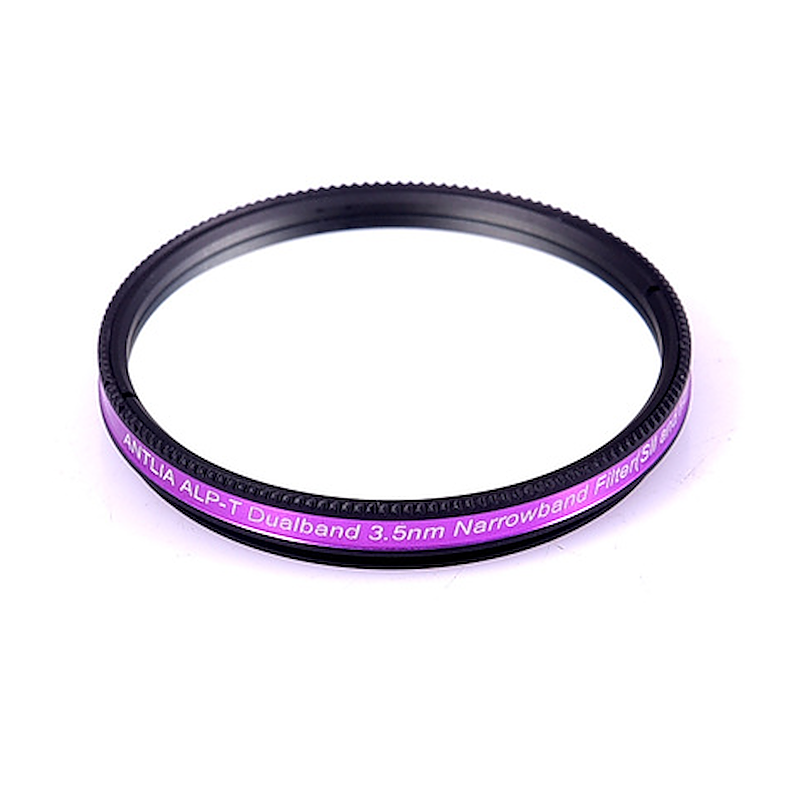
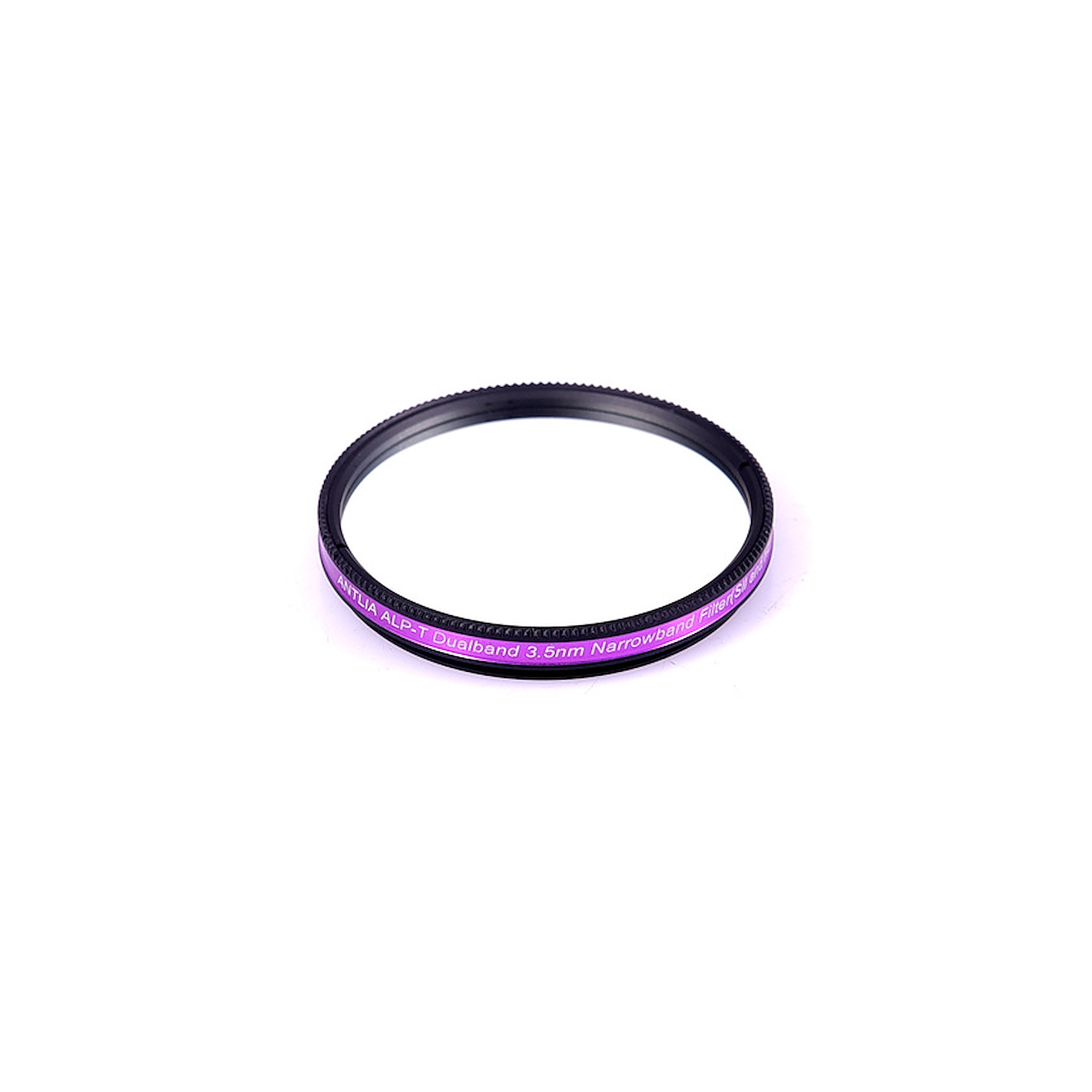
The 3.5 nm ALP-T dual-band SII&Hb filter is a dual narrowband filter that lets through the 672.4 nm deep red sulfur-II and 486.1 nm blue hydrogen-beta lines and is designed primarily for color cameras to help astrophotographers image the deep sky with superior signal-to-noise ratio (SNR). With a mid-bandwidth FWHM designed at 3.5 nm and achieving an optical density (OD) of 4.5 at unwanted wavelengths, it works strongly to block light pollution, moonlight and airglow, resulting in enhanced contrast in nebula images by effectively passing only the signal from the SII and H-beta emission lines.
| Carrier | Description | Estimated Delivery | ||
|---|---|---|---|---|
 |
UPS - Resto del mundo | UPS - Rest of the World |
Tuesday, 10 February - Tuesday, 17 February |
|
UPS - Resto del mundo
UPS - Rest of the World
Estimated delivery:
Tuesday, 10 February - Tuesday, 17 February
Passes SII 672.4 nm and H-Beta 486.1 nm lines
Captures the two main emission bands in deep red and blue at the same time
Ultra FWHM 3.5 nm design allows for increased exposure time and captures detailed nebular signals.
Designed for use primarily with color cameras to capture cleaner data or use as mono cameras with luminance filter to save imaging time.
It is recommended for use with the ALP-T Dual Band Ha&OIII filter to create images with better signal-to-noise ratio (SNR) and better isolation between the 4 channels.
Optical Density (OD) 4.5 suppression at unwanted wavelengths improves SNR.
Near infrared (NIR) is blocked up to 1100 nm
Ideal flat top and moderate bandpass reduces downward shifts in the spectrum
The filter is recommended for use with optics with f-ratios slower than f/4 for best performance; for optics faster than f/4, the pre-shifted high-speed version is a better choice.
Ion gun-assisted deposition of double-sided multilayer coating technology on the double-sided polished substrate, making it the most consistent and accurate light pollution suppression filter.
Anti-reflection coating with halo suppression is used to minimize halo and internal reflections.
Designed to suppress artificial illumination from Bortle scale 1 to Bortle scale 8
Blackened edges of unmounted sizes to minimize internal reflections
Antlia's always-reliable coating technology makes the filter's durability highly reliable
Although primarily designed for use with color cameras, the filter is also very effective with monochrome cameras to save image capture time.
| Sulfur-II | Hydrogen-Beta | |
| FWHM | 3.5nm +0.5/-0.5nm | 3.5nm +0.5/-0.5nm |
| CWL (Central Wavelength) | 672.4 nm | 486.1 nm |
| Maximum transmission | 90% | 85% |
| Blocking | ≥OD4.5 at 300-1100 nm | |
| Filter thickness | 2 mm +/- 0.05 mm | |
| Basic substrate | Optical substrate, single/no glue | |
| Surface quality | S/D (scratch/excavation) = 60/40 (see MIL-O-13830) | |
| Transmitted wavefront | Lambda/4 or better | |
| Parallelism | less than 30 arc seconds | |
| Filter ring | 2'' (M48*0,75) | |
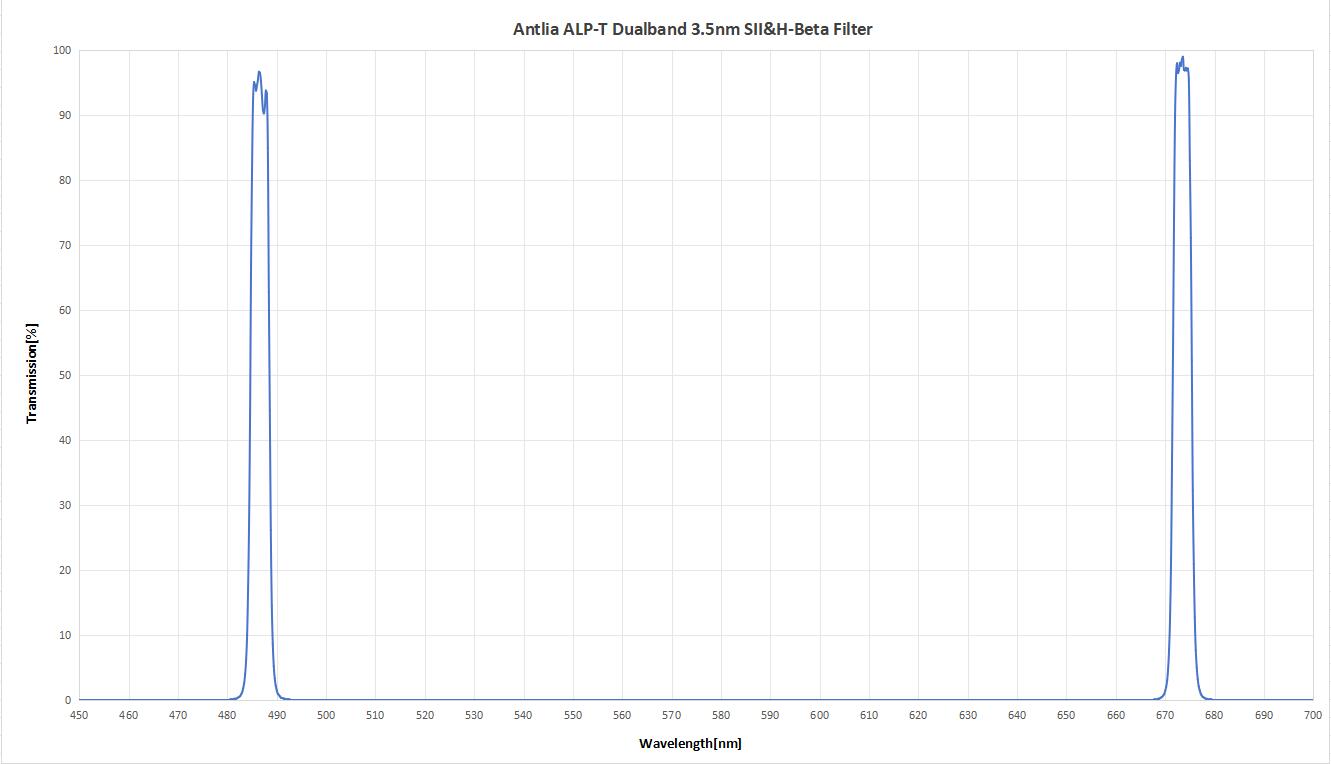
This is an important addition to the popular Antlia ALP-T dual-band Ha&OIII filter and allows for false-color imaging and OSC imaging of narrow-band nebulae. By capturing data with this filter, nebulae are recorded with high signal-to-noise ratios and higher contrast than without it.
The combination of these two dual-band Ha&OIII and SII&H-beta filters allows extreme narrow-band imaging with OSC cameras by capturing the spectral data of 4 channels, i.e., Ha/OIII/SII/Hb. The spectra of these four channels can be separated and recombined into various color palettes in post-processing. The resulting images can be used to enhance the luminance contrast of traditional RGB-balanced images or to create images in various popular false color palettes, such as H-O-Hb, S-H-O, H-S-OHb, H-O-O-O, etc.
The advanced multiple coatings of the Antlia ALP-T dual-band filters effectively isolate the red, Ha, blue-green, OIII, deep red SII and blue H-beta lines of emission nebulae, with near-total suppression of optical density (OD)4.5 at unwanted wavelengths from light pollution, moonlight and airglow. The result is that both the ALP-T Ha&OIII and SII&Hb dual band versions create a superior signal-to-noise ratio and improved contrast in their CSO images, whether used in urban or rural areas, making them excellent choices for astrophotographers looking to capture high quality, more detailed celestial images.
By purchasing 2 filters of the Ha&OIII version and the SII&H-beta version as a COMBO, you can get them at a better price.
Solar imaging
Night visual observation
DO NOT LOOK DIRECTLY AT THE SUN WITH THIS FILTER
Failure to heed the warning will result in serious eye damage.
The filter is dedicated to capture H-beta and SII emission lines. We know that SII is simply ionized sulfur that emits light in the deep red part of the spectrum beyond H-alpha, but the contribution of H-beta to emission lines in nebulae is often overlooked, even though it is the second most common hydrogen emission after the H-alpha line. Capturing more OIII will enhance the existing signal, but will not provide more information. However, H-beta has the potential to reveal structures not seen using OIII. The design is to capture the H-beta emission line in certain nebulae that contain some blue spectrum, this cannot be captured by the H-alpha, SII and OIII filters. Larger and richer details will be captured in many nebula images to achieve results with a superior signal-to-noise ratio.
It is generally accepted that the OIII signal is a relatively weaker contributor to nebula images. The sensitivity of the OIII bandpass is an important consideration for any nebula filter. Most color cameras (OSCs) use a Bayer RGGB pattern. Allocating twice as many green pixels compared to red or blue pixels allows for much better capture of the OIII signal. In addition, a higher OIII signal can be achieved by additional exposure using the Antlia ALP-T Ha&OIII filter, then isolating the GB channels, followed by synthesis of an OIII channel to add to your stack.
In the situation where you only want to add SII to your Ha&OIII data, then it may be preferable to purchase a narrowband SII filter and achieve a cleaner SII spectral output. However, our new filter design (SII&Hb) includes the H-beta emission line which provides a distinct improvement in nebula contrast and better feature separation in the H-beta areas.
Antlia ALP-T Dual Band Ha&OIII Filter: Dual band filter with a very narrow passband in OIII and H-alpha for higher signal-to-noise ratio. The resulting contrast enhancement for OSC is impressive.
Antlia ALP-T Dual Band SII&Hb Filter: Dual band filter with a very narrow passband on H-beta and S-II. This filter is ideal for increasing the contrast of nebulae emitting in the sulfur and H-beta range using OSC. It provides additional feature separation and isolation in Hb areas.

Deliver it 15/22 days